The building had to be raised around the boat. Before any of the curved glue-lam beams of the Columbia River Maritime Museum's new Warnock Building went up, a crane set the 52-foot Coast Guard motor lifeboat Triumph II into a custom pit. It was too big to fit through the north roll-up door of the finished hall. "It was like a huge jigsaw puzzle putting the building together," Caroline Wuebben, the museum's director of external engagement, told Oregon ArtsWatch. That hall opens to the public at 1 p.m. this Friday, Nov. 20, at 1792 Marine Drive. Locals have the strongest reason to go, because a good share of what's inside was built, worked or crewed within a few miles of the front door.
The boats with Astoria names on them
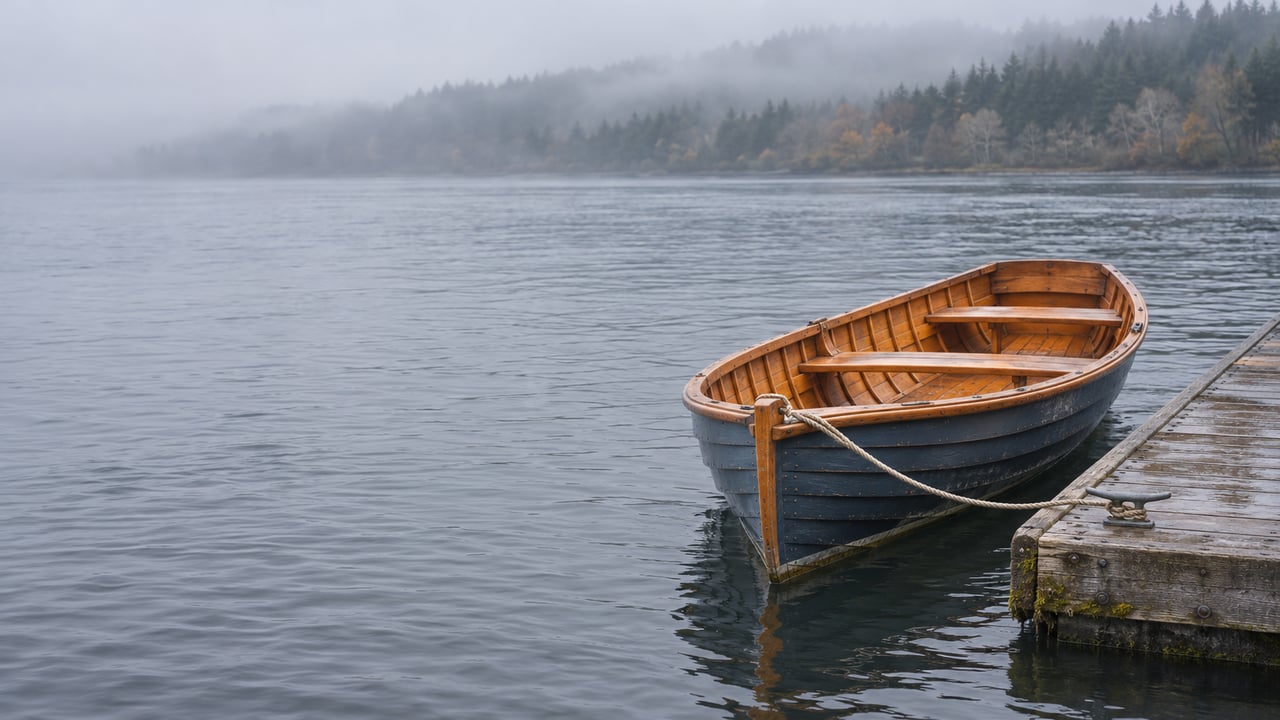
The Warnock Building holds 19 vessels. According to The Astorian, the highlights read like a short history of the town's own waterfront:
- Merrimac, a classic wooden yacht built in 1938 by Astoria Marine Construction Company
- A fishing vessel built by Astoria's Wildon Brothers and Bumble Bee shipyards
- A log bronc, the stubby workhorse boat loggers used to push timber around rivers and mill ponds while balancing on wet logs in spiked "corks" boots
- Triumph II, the 52-foot motor lifeboat, one of only four of its kind built for the Pacific Northwest
- A 60-foot racing shell by George Pocock that weighs 300 pounds
A full-size U.S. Coast Guard helicopter hangs from the ceiling above them. Forensic anthropologist Gloria Nusse sculpted its crew. ArtsWatch reported that the museum wanted figures that "add to the exhibit without being a mannequin." A core group of four volunteers did the scraping, painting, building and fixing that readied the boats for display.
The building also brings out hundreds of artifacts that have never been displayed. If your family has a grandparent who worked the canneries, the boatyards or the river, this hall is built around the work they did.
A building shaped like the river it describes
Portland's Opsis Architecture designed the roughly 24,500-square-foot, two-level building. ArtsWatch describes an all-wood frame and roof with no right angles, where every beam and roof panel was specific to its location.
"The building swoops, it curves, it moves. It's very fluid when you're there." Caroline Wuebben, in Oregon ArtsWatch
The same idea runs through the art. In the lobby, Port Townsend artist Margie McDonald has woven a 60-by-300-inch piece of marine rope on a steel frame. McDonald invented the McDonald Brummel, a rope splice used around the world. The installation maps the Columbia and its tributaries in knots. Its five waves stand for the five Oregon rivers that feed the Columbia, and the plunging knots stand for the tangles a boat has to work through to cross the confluence safely. Anyone who has watched a ship wait off the bar will know what it means.
The building also holds the 1868 first-order Fresnel lens from the Cape Mendocino Light in California. It is about 14 feet tall and weighs 8,000 pounds. It was packed away in 2012, donated to the museum in 2023, and reassembled by lampist Chad Kaiser. Energy Trust of Oregon also named the building one of its spotlight projects for the year, ArtsWatch reported.
The rooms built for kids who live here
Out-of-town visitors will come for the boats. For families in Astoria, the bigger change may be the classroom. ArtsWatch reports it is the first purpose-built classroom in the museum's almost 65 years. It has a sheltered tank for remotely operated vehicles, where students from elementary through high school can build and steer underwater robots. Until now, that robotics program could run only in fair weather. With the tank indoors, the museum can offer it more often, including in the rainy months.
The new building has about 3,700 square feet of STEAM learning space, plus an area where younger children can play and learn near the classroom. The interactive areas are called STEAMworks and Block Harbor. They share the building with the two-story McGowan boathouse, a Riverfront Theater, the Ship's Store, and the Bulkhead, a two-sided, two-story wall of images and artifact cases that runs the full length of the building. On a wet Saturday in December, that adds up to a long afternoon indoors.
The half you already know got rebuilt too
ArtsWatch reports that the $34 million Warnock Building nearly doubles the museum's space. Meanwhile, 11,000 square feet of the original building were remodeled with upgraded exhibits and two new Indigenous exhibits. That original building has a new name too. It is now the Klep Building, after museum founder Rolf Klep. The new one is named for Gerald Warnock, a major donor to the project. A covered walkway connects the two.
Construction started in November 2024. The museum's staff kept the original building running the whole time while also getting the new one ready. Executive director Bruce Jones told The Astorian he "couldn't be prouder" of the team. If you haven't been inside since before the work began, both buildings will be new to you.
What a visit takes on Nov. 20 and after
Regular admission applies on opening day, and members get in free. Here are the museum's posted rates. Check crmm.org before you go, since the price pages aren't dated.
| Ticket | Posted price |
|---|---|
| Adults 18+ | $18 |
| Seniors 65+ | $15 |
| College students 18+ with ID | $15 |
| Children 6 to 17 | $8 |
| Children 5 and under | Free |
| Active-duty military and members | Free |
| EBT/WIC cardholders, up to four people | $3 each |
| Lightship only, or each 3D film | $5, free for members |
The museum has no general resident discount. The Hometown Tourism Days offer of free admission with local ID was for Nov. 11 only. If you plan to come back for a second look at the boats, compare a membership with the ticket price. Annual memberships start at $50 for Ensign and $75 for the Crew level. The museum also offers a $38 Crew/Family membership to eligible EBT/WIC recipients, bought in person with the card and a photo ID.
The museum is open daily from 9:30 a.m. to 5 p.m. It closes on Thanksgiving Day and Christmas Day. The Lightship is open 11 a.m. to 3 p.m., depending on conditions that day. Parking is free, and the campus lot is growing from 170 to 205 spaces. You can drive in at 17th, 18th or 20th streets. If you're coming from the east, the museum suggests the 20th Street entrance and the Pilot Boat Peacock lot, then a walk along the Riverwalk to the main entrance. The route from the lots crosses railroad tracks. The barrier-free entrance is the south museum entry.
Thanksgiving week, with the museum in it
The opening lands at the start of a busy stretch downtown. If you're hosting guests, here's how the museum fits around the other events:
- Friday, Nov. 20: Mariners Hall opens at 1 p.m. Shop Plaid also begins downtown and runs through Nov. 27. Three purchases earn a tote, and five enter you in a gift-card drawing held at the tree lighting.
- Saturday, Nov. 21: The free Family Ornament Decorating runs from 1 to 3 p.m. at the Astoria Public Library. The ornaments go on the community tree.
- Thursday, Nov. 26: The museum is closed for Thanksgiving.
- Friday, Nov. 27: Englund Marine at 95 Hamburg Ave. holds its Day After Thanksgiving sale from 7:30 a.m. to 5:30 p.m., with discounts on rain gear and boots. The museum reopens at 9:30.
- Saturday, Nov. 28: The free Downtown Holiday Lighting Ceremony runs from 4:30 to 5:30 p.m. at the Liberty Theatre, 1203 Commercial St. It includes the Strecker Family Band, hot chocolate and Santa. The museum closes at 5, so a morning with the boats and an evening downtown fit into one day.
- Sunday, Nov. 29: The Astoria Holiday Market opens at the Armory, 1636 Exchange St., from 10 a.m. to 3 p.m. with more than 60 vendors. It returns Dec. 6.
The film mural at 9th and Duane also makes a good stop on the walk between Marine Drive and Commercial Street. It celebrates 11 films and TV shows shot in Oregon, Astoria productions among them. For more on how the town schedules itself around its landmarks, see our post on the Astoria Column's centennial week.
If you're showing family around Astoria this month and want ideas for the rest of the North Coast, or if a visit to the boatyard exhibits gets you curious about the working waterfront neighborhoods they came from, I'm always happy to talk. Reach out to Cindy Hawkins Colley anytime. Let's Connect.